

Round Engagement Rings vs Fancy Shapes: Which Sparkle Fits You?
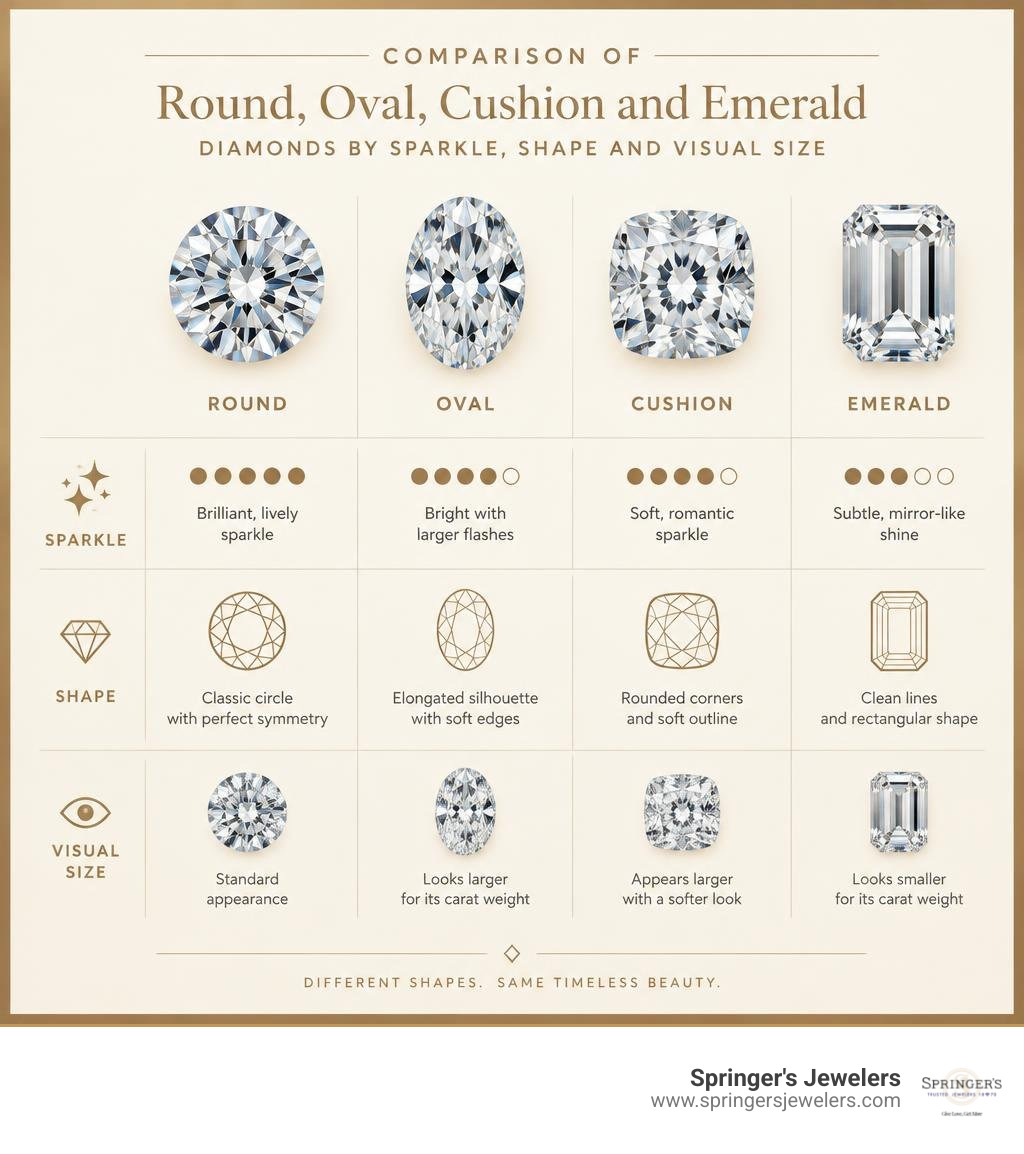
Choose a round engagement ring if you want a classic look and bright, lively sparkle. A well-cut round brilliant is designed to return light from many angles. Fancy shapes offer different strengths: ovals can look larger for their carat weight, cushions have a softer outline, and emerald cuts offer a quieter, mirror-like shine. Round diamonds often cost more per carat than comparable fancy shapes, so compare the look and the price before you decide. The Gemological Institute of America (GIA) provides a useful diamond shape buying guide that explains how cut design affects light performance.
We’re Springer's Jewelers, Northern New England’s oldest jeweler, serving customers since 1870. Our experience helping people choose round engagement rings starts with a simple question: which shape will you love wearing every day?
The Enduring Appeal of Round Engagement Rings
Choosing a center stone is the cornerstone of designing an heirloom piece. The round brilliant shape has reigned supreme across generations because of its unmatched optical symmetry, balance, and pure visual energy. When you look down at a beautifully cut round diamond, light leaps back at you from every angle, delivering exceptional white light return (brilliance) and vivid flashes of spectral color (fire).
The circular silhouette complements every finger type, pairs seamlessly with nearly any mounting style, and looks just as modern today as it did a century ago. Unlike vintage fads that come and go, the round cut remains the definitive standard against which all other diamond cuts are measured.
Why 57 to 58 Facets Maximize Brilliance and Fire
The secret to the round diamond's dominance lies in mathematical physics. In 1919, engineer and mathematician Marcel Tolkowsky calculated the ideal proportions and angles required to optimize light performance in diamond cutting. This gave birth to the modern round brilliant cut, which features 57 or 58 precisely placed facets (58 if a culet facet is present at the base).
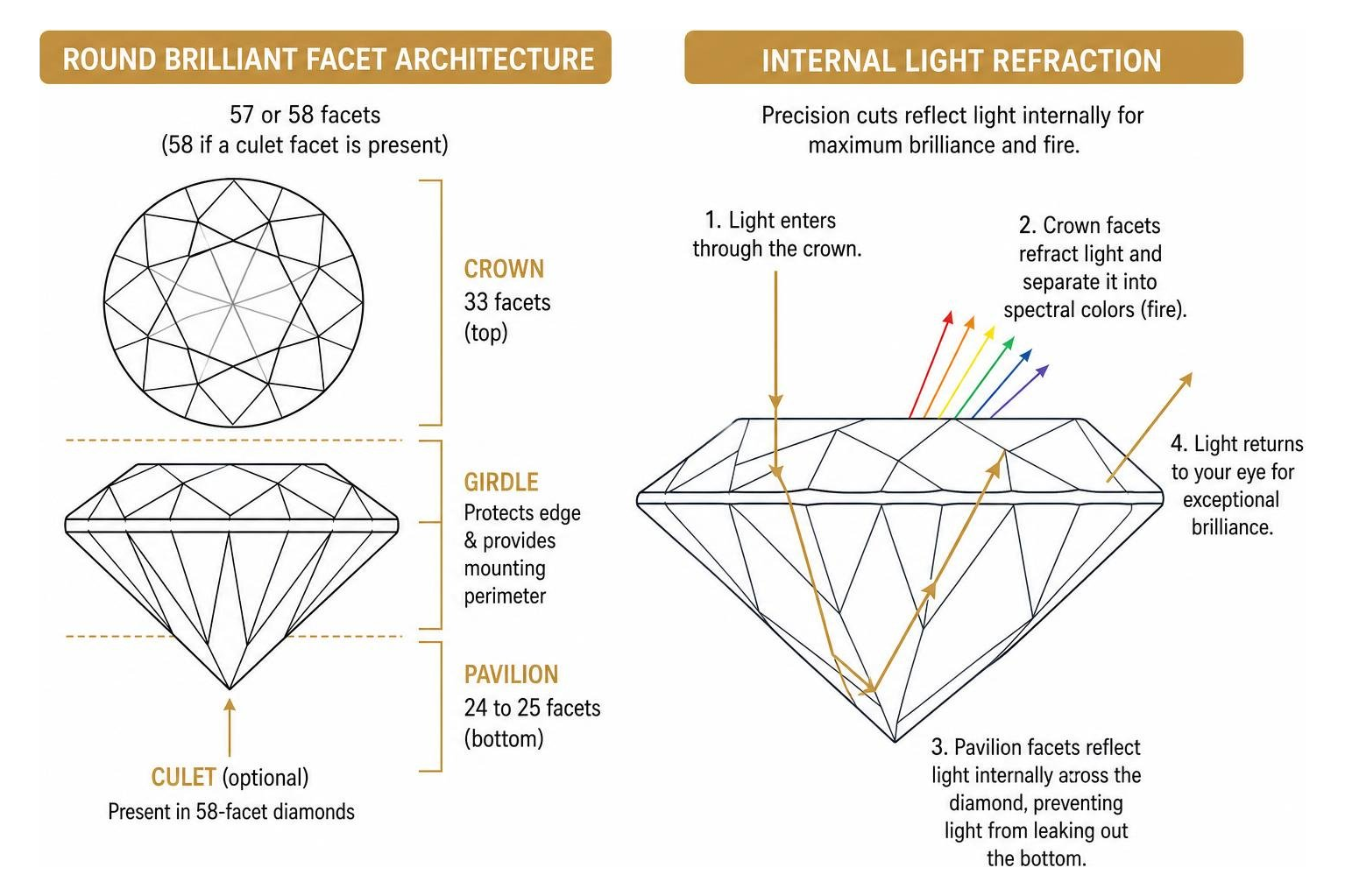
The facet geometry functions like a complex miniature hall of mirrors:
- The Crown (top 33 facets): Acts as the entry window and prism, splitting incoming white light into its spectral rainbow components (fire).
- The Girdle: Protects the diamond's edge and provides the structural mounting perimeter.
- The Pavilion (bottom 24 to 25 facets): Features a steeply angled cone designed to reflect light internally across the diamond rather than letting it leak out the bottom.
When incoming rays enter the crown, they bounce internally from facet to facet across the pavilion before shooting directly back out through the top toward the viewer's eye. This intense balance of brightness and contrasting dark patterns creates dynamic scintillation—the signature sparkle that makes round diamonds visibly energetic under candlelight, bright sun, or ambient indoor lighting.
Carat Size and 4Cs Guide for Round Engagement Rings
When navigating the 4Cs (Cut, Color, Clarity, Carat Weight) for round cuts, your absolute top priority should always be Cut Quality. Because the round shape is built strictly for light performance, an "Ideal" or "Excellent" cut will make a stone look brighter, whiter, and even larger than a poorly cut diamond of a higher carat weight.
Here is how to optimize the other three Cs:
- Clarity: The intense sparkle of 58 facets excels at hiding minor natural inclusions. You rarely need an internally flawless stone; choosing a VS1, VS2, or eye-clean SI1 clarity grade will offer stunning beauty while freeing up your budget.
- Color: Round brilliants concentrate light so effectively that stones in the G to J range face up remarkably white, especially when set in yellow gold or rose gold. If you prefer bright white gold or platinum, stones in the D to F range provide an icy, ultra-crisp presence.
- Carat Weight: Diamond pricing jumps at major milestone weights (1.00ct, 1.50ct, 2.00ct). Buying just below these thresholds (such as 0.90ct or 1.40ct) can yield significant savings with virtually zero visible size difference.
For lovers of character and heritage, an estate 1.50ct round brilliant solitaire ring offers unmatched historical romance alongside distinct value. Whether you choose natural stones or modern lab-grown alternatives graded by accredited institutes like the International Gemological Institute (IGI), insisting on stringent cut grading ensures your center diamond lives up to its full potential.
Round Brilliant vs Fancy Diamond Shapes: Key Comparisons
Every diamond shape that is not a standard round brilliant is classified as a "fancy shape." These include elongated shapes like ovals, pears, and marquises; square and rectangular shapes like princess, cushion, radiant, and emerald cuts; and geometric vintage cuts like Asschers.
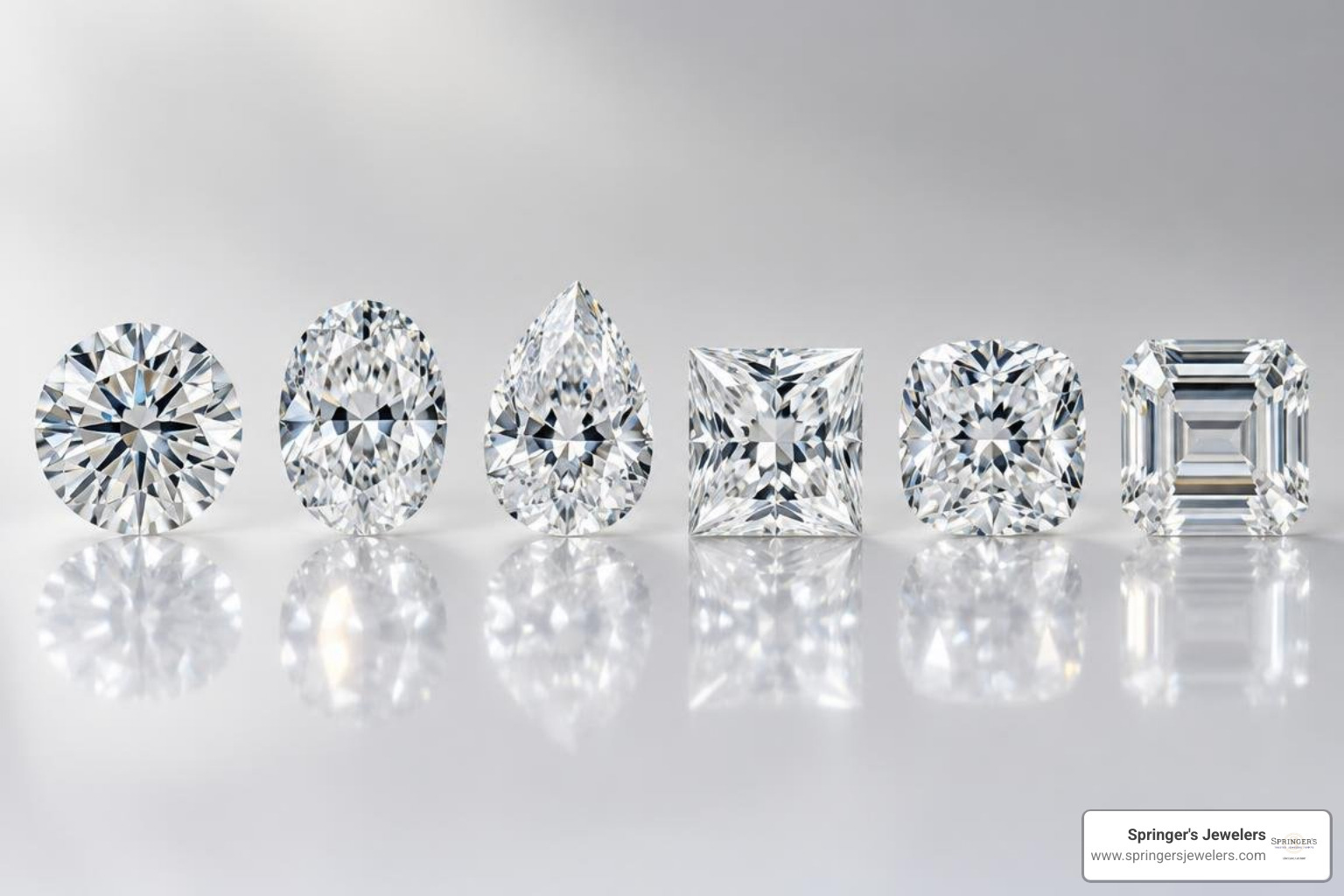
Comparing Round Diamonds to Popular Fancy Shapes
Fancy shapes each carry their own design personality, physical dimensions, and trade-offs. The table below breaks down the key performance indicators across the most popular cuts:
| Diamond Shape | Sparkle Style | Finger Coverage (Face-Up Size) | Relative Price Per Carat | Key Optical Characteristics |
|---|---|---|---|---|
| Round Brilliant | Maximum brilliance, fire, and dynamic scintillation | Standard baseline | Premium ($$$$) | 57–58 facets; zero bow-tie effect; completely symmetrical light distribution |
| Oval Cut | Brilliant sparkle, similar to round | High (elongated silhouette) | Moderate ($$$) | Elongated shape makes fingers appear slender; can exhibit a central "bow-tie" shadow |
| Princess Cut | Bright geometric flashes; pyramid-like brilliance | Moderate | Value ($$) | Sharp 90-degree corners; requires 4-prong corner protection; modern contemporary look |
| Cushion Cut | "Crushed ice" fire or broad chunk sparkle | Moderate to low (deep pavilion) | Moderate ($$) | Soft pillow edges; romantic antique aesthetic; hides minor inclusions well |
| Emerald Cut | Hall-of-mirrors step-cut flash | High (broad open table) | Value to Moderate ($$) | Dramatic flashes rather than glittery sparkle; reveals inclusions easily |
While elongated shapes like the oval offer more finger spread per carat, they can suffer from a light-extinction pattern known as the bow-tie effect across their center width. Step cuts like the emerald prioritize crisp architectural transparency over rapid-fire sparkle. If your primary goal is pure, blinding light performance with no dark dead zones, the round brilliant remains untouched.
Lab-Grown vs Natural Round Diamonds
Both lab-created and mined diamonds are 100% genuine diamonds. They share the identical carbon crystal lattice, a rating of 10 on the Mohs hardness scale, a refractive index of 2.42, and identical brilliance.
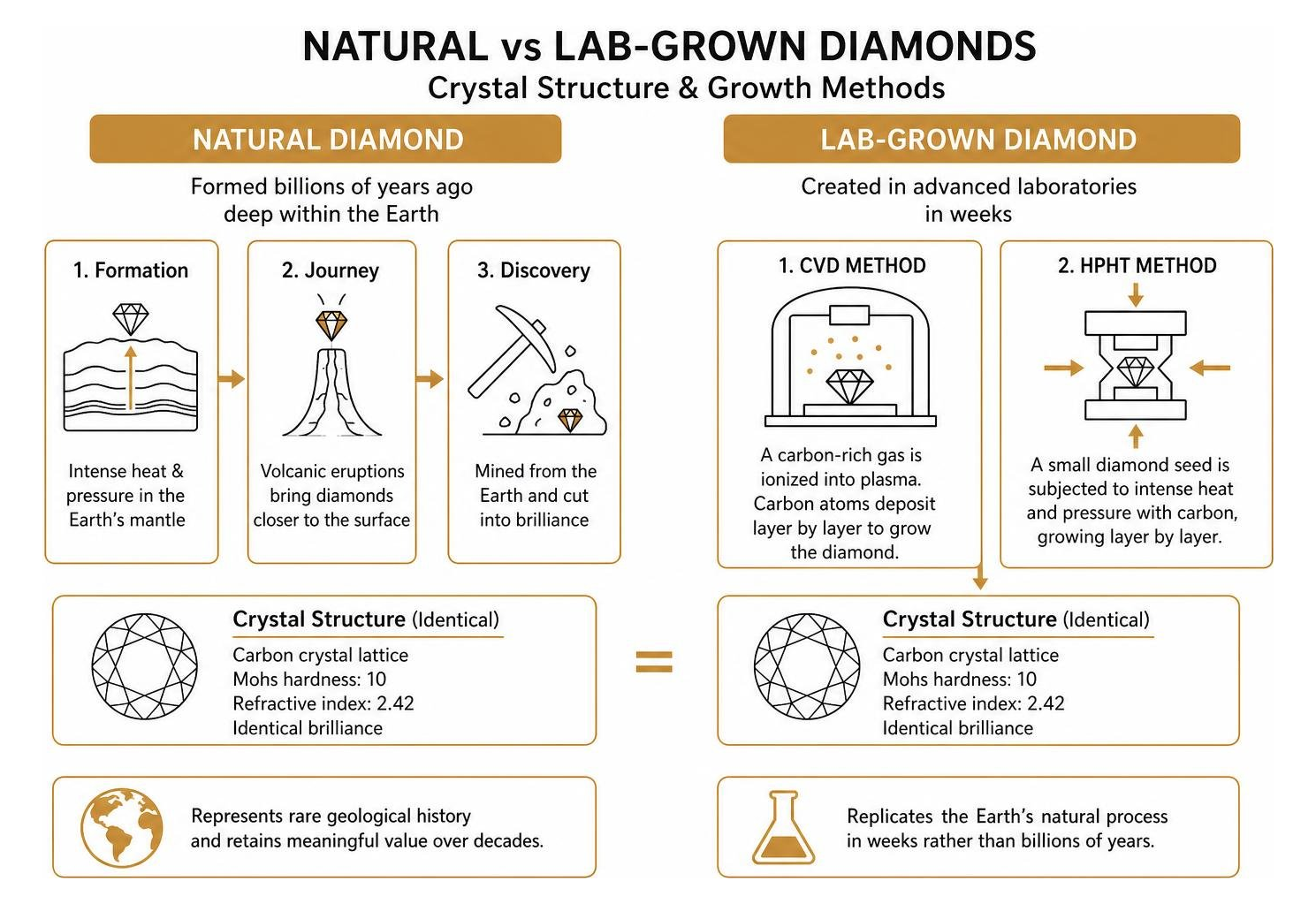
- Natural Diamonds: Formed billions of years ago under intense heat and pressure deep within the Earth's mantle. Mined diamonds represent rare geological history and retain meaningful intrinsic value over decades. You can explore our diverse selection of natural diamond engagement rings to appreciate their natural rarity.
- Lab-Grown Diamonds: Created in advanced technological laboratories using Chemical Vapor Deposition (CVD) or High-Pressure High-Temperature (HPHT) methods. They replicate the Earth's natural crystallization process in weeks rather than eons.
Choosing between natural and lab-grown comes down to personal values: do you treasure natural geological rarity and generational heritage, or do you prefer maximizing carat weight and clarity within a set budget?
Setting Styles and Custom Mountings
The diamond shape sets the tone, but the mounting creates the personality. Because round center stones are balanced, they can be set into almost any architecture—from clean, minimalist bands to ornate, vintage-inspired frames.

Popular Setting Styles for Round Engagement Rings
Here are the primary mountings that highlight a round brilliant diamond:
- Classic Solitaires: The timeless gold standard. Clean, unadorned bands direct 100% of the viewer's attention to the center stone. You can browse our variety of solitaire engagement rings, or opt for the refined, graceful lines of a Vlora 18K white gold style mounting to let a round diamond float effortlessly.
- Hidden Halo Mountings: A modern favorite that introduces a subtle collar of pavé diamonds directly beneath the center stone's girdle. It provides an unexpected secret sparkle from the profile view while preserving a clean top-down look, beautifully embodied in this Springer's Forever Signature hidden halo mounting.
- Pavé and Accent Mountings: Setting micro-diamonds into the band itself adds continuous shimmer along the finger. A design like the Springer's Forever Select diamond engagement mounting enhances total carat weight and broadens the overall radiance of the piece.
- Bezel Settings: A thin rim of precious metal entirely wraps the perimeter of the diamond. Bezel settings offer a sleek, ultra-modern silhouette while delivering the absolute highest level of snag-free protection for active lifestyles.
Side Stones, Pavé Accents, and Three-Stone Designs
If you want to move beyond a single center stone, accent diamonds can transform the silhouette of a round ring:
- Tapered Baguettes: Stepped rectangular side stones direct the eye straight inward, highlighting the round center stone's curves with a mid-century Art Deco touch.
- Three-Stone (Trinity) Arrangements: Flanking a round brilliant with two smaller round or pear-cut side stones creates a meaningful motif representing your past, present, and future together.
- Intricate Shank Details: A mounting like the Sincerely Springer's by Vlora engagement mounting utilizes side diamonds to create a textured, shimmering stage for a round center stone.
Precious Metals and Bridal Stacking
The metal you choose affects not only the ring’s color contrast, but also its weight, skin feel, and long-term maintenance requirements.
Choosing the Right Metal: Platinum, White, Yellow, and Rose Gold
- Platinum: The most durable and secure of all precious metals. Platinum is naturally white, dense, hypoallergenic, and never requires replating. Over time, it develops a satin finish known as patina, which many collectors cherish.
- 14K vs 18K White Gold: White gold is alloyed with white metals (such as nickel or palladium) and coated in rhodium for a mirror-like shine. 14K white gold offers enhanced scratch resistance for active wear, while 18K provides a higher pure gold content. White gold requires occasional rhodium re-dipping to maintain its bright luster.
- Yellow Gold: Rich and warm, yellow gold provides a striking, traditional contrast against the icy white sparkle of a round brilliant. It is forgiving with lower color-grade diamonds (such as I or J), making them appear bright and harmonious.
- Rose Gold: Created by alloying pure gold with copper, rose gold gives off a romantic, vintage blush tone that complements every skin complexion.
Pairing Wedding Bands and Personal Customizations
Round engagement rings offer the easiest wedding band pairing of any diamond shape. Because round heads can be engineered with open under-galleries, a straight diamond band will often sit flush against the engagement ring without leaving an awkward gap.
If you prefer a distinct bridal stack, consider:
- Contoured or Curved Bands: Follow the gentle arc of the round center setting for an integrated, nesting look.
- Eternity Bands: Accentuate the round center stone with a continuous circle of shared-prong round diamonds.
- Custom Engraving: Adding a special anniversary date, personal coordinates, or hidden initials inside the inner comfort-fit shank creates a one-of-a-kind connection.
Explore our full engagement rings collection to experiment with different metal tones, profiles, and stacking combinations.
Frequently Asked Questions About Round Diamonds
Are round diamonds more expensive per carat than fancy shapes?
Yes, round brilliant diamonds typically carry a higher price per carat than fancy shapes of equivalent carat weight, color, and clarity. This price premium comes down to two primary factors:
- Rough Diamond Yield: Cutting a round diamond from rough octahedral diamond crystal results in a higher loss of raw material (often 50% to 60% discarded) compared to shapes like princess or cushion cuts, which preserve more of the original rough stone.
- Precision Engineering & Demand: Round diamonds require exacting cutting tolerances to achieve optimal light performance and remain the most heavily requested diamond shape worldwide.
What diamond color and clarity offer the best value for round cuts?
The sweet spot for balancing beauty and value in a round diamond is generally G to H color paired with VS2 or eye-clean SI1 clarity.
Because a round brilliant cut's 58 facets reflect so much light back to the viewer, the intense sparkle naturally masks minor internal inclusions and conceals trace body warmth. Stepping down from a flawless D color stone to an eye-clean G or H stone can save thousands of dollars without any difference visible to the unaided eye.
How do I choose between a 4-prong and 6-prong round setting?
- 4-Prong Settings: Allow more light to enter the diamond from the sides and make the center stone appear slightly more geometric, emphasizing its overall size.
- 6-Prong Settings: Provide superior structural security (if one prong is damaged, the diamond remains firmly in place) and trace the circular contour of the stone, accentuating its true round shape. Six-prong heads are highly recommended for center diamonds 1.50 carats and larger.
Conclusion
Finding the diamond shape that tells your story is a deeply personal journey. While fancy shapes like ovals, cushions, and emerald cuts offer distinct vintage charm and elongated lines, the round brilliant diamond remains an unmatched masterpiece of light engineering, scintillation, and timeless elegance.
At Springer's Jewelers, our family has guided New England couples through life’s most meaningful milestones since 1870. Whether you are looking for a bespoke mounting, a natural diamond, or a certified lab-grown center stone, our four generations of bridal expertise are here to help you select a piece that shines for a lifetime.
Visit our welcoming showrooms in Portland and Bath, Maine, or Portsmouth, New Hampshire, or browse our complete engagement ring selection online to begin designing your dream ring today.