


Choose Bangle Bracelets for a Modern, Lasting Look
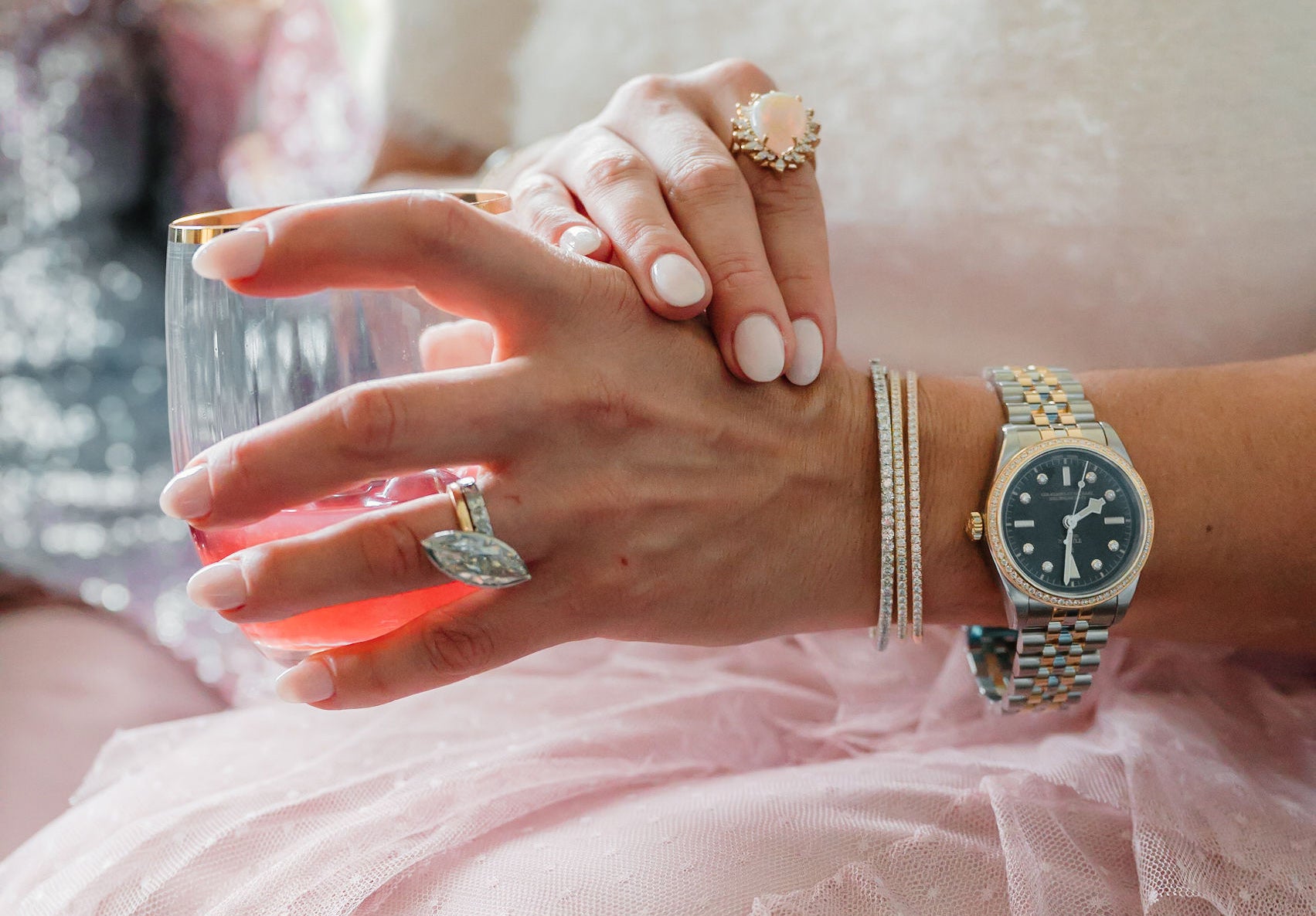
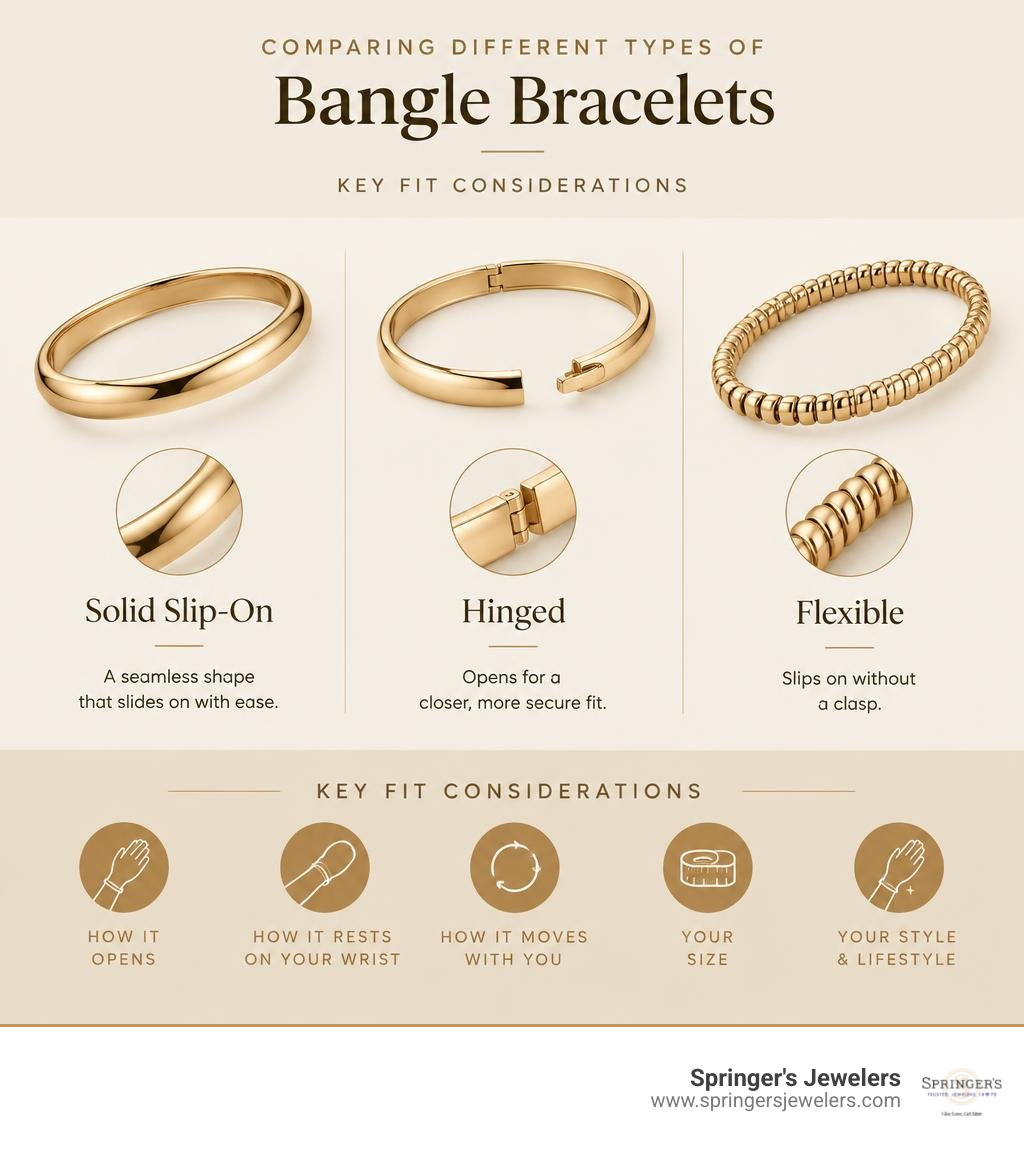
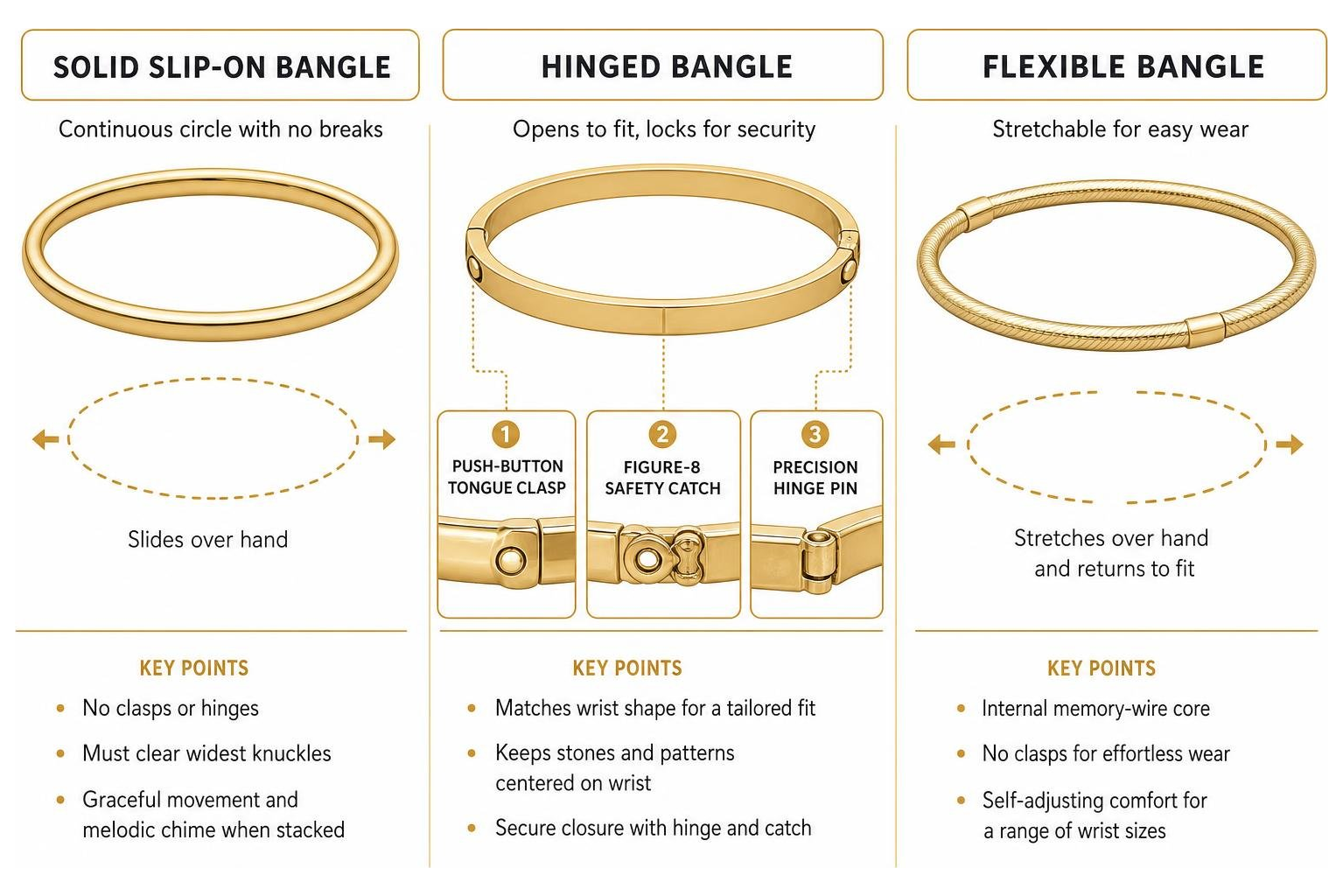
For a clean, modern look, start with the construction that suits you: solid slip-on bangles have a seamless shape, hinged bangles open for a closer fit, and flexible bangles slip on without a clasp. Wear one bold bangle on its own, or stack a few slim styles with different textures beside a watch or tennis bracelet.
At Springer's Jewelers, we've helped customers choose lasting jewelry since 1870. We bring that experience to finding bangle bracelets that feel right for your style and your daily life. For a broader look at how bangles compare with other wristwear, the Gemological Institute of America offers a useful bracelet buying guide.
Comparing Different Types of Bangle Bracelets
Finding the right bangle comes down to how it opens, rests against your wrist, and moves with your daily routine. Unlike supple chain bracelets that drape softly, structured bangles hold a distinct geometric silhouette. Choosing the right construction ensures your bracelet stays secure, feels comfortable, and flatters your wrist proportions.
| Bangle Type | Closure Mechanism | Fit Profile | Sizing Focus | Best For |
|---|---|---|---|---|
| Solid Slip-On | Seamless (No clasp or hinge) | Relaxed, fluid movement | Hand circumference (widest knuckle span) | Classic stacking, traditional heirloom aesthetics |
| Hinged & Clasp | Push-button, tongue-in-groove, or side safety | Anatomical, tailored wrist contour | Wrist circumference | Diamond-accented statements, petite wrists, close fit |
| Clasp-Free Flexible | Expandable memory wire or internal titanium coil | Self-adjusting, snug resilience | Universal (accommodates 5.5"–8.5" wrists) | Active lifestyles, effortless on-and-off wear, hassle-free gifting |
Solid Slip-On Bangles
Solid slip-on bangles are the traditional foundation of bracelet design. Crafted without breaks, clasps, or hinges, these continuous metal circles slide directly over your hand. Because they must clear your widest knuckle span, they naturally fit more loosely around the wrist, offering a graceful, fluid movement and that signature melodic chime when stacked together.
Fine solid slip-on bangles require exceptional structural integrity to prevent warping over time. A classic handmade 14K yellow gold bangle showcases how seamless metalwork creates a clean, timeless silhouette. Slip-ons are ideal for collectors who enjoy permanent or semi-permanent jewelry wear, as their lack of moving mechanical parts means zero hinge wear or clasp fatigue over decades of enjoyment.
Hinged and Clasp-Secured Bangles
If you prefer a bracelet that closely mirrors the natural oval shape of your wrist rather than sliding up and down your forearm, a hinged bangle is the gold standard. These designs feature a discreet mechanical joint on one side and a secure closure on the other. Common fastening mechanisms include push-button tongue clasps, pressure-insertion tabs, and dual figure-eight safety catches.
Hinged engineering allows the inner diameter to match your wrist measurement rather than your hand size. This tailored fit keeps diamond rows, gemstones, and intricate patterns sitting proudly on top of your wrist instead of flipping downward. For a sophisticated fine-jewelry look, a 14K white gold diamond hinged bangle provides structured sparkle that stays perfectly centered. The same tailored security makes hinged mechanics an enduring favorite in estate collections, visible in historic designs like a vintage amethyst hinged bangle, where fine gemstone settings require a steady, protected position on the arm.
Clasp-Free Flexible Bangles
Flexible bangles offer the sleek look of fine jewelry with effortless comfort. Built around an internal carbon-steel or titanium memory-wire core, these expandable bangles stretch comfortably over your knuckles and spring back into shape around your wrist.
This style eliminates tricky clasps and delivers a comfortable, self-adjusting fit. A fine flexible diamond bangle bracelet allows you to slip brilliant pavé diamonds on and off in seconds without sacrificing security. For modern mixed-metal styling, an expandable gold and platinum bangle blends innovative tension design with heirloom metals, easily fitting wrists ranging from 5.5 to 8.5 inches.
Metal Durability: Solid Gold vs. Gold-Filled vs. PVD Stainless Steel
Choosing the right metal ensures your bangle matches your everyday routine, skin sensitivities, and personal style.
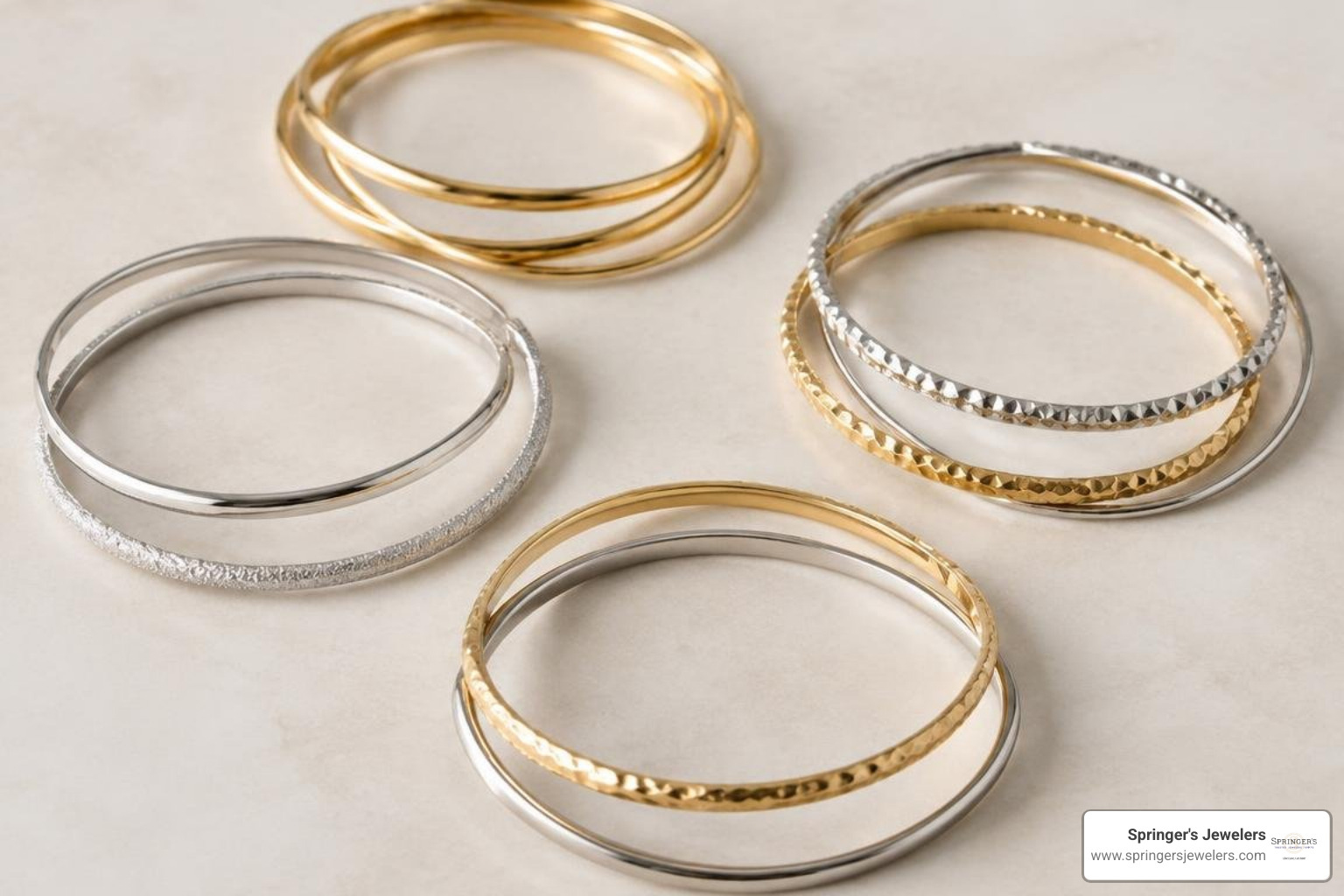
| Metal Category | Composition & Coating | Tarnish Resistance | Water & Sweat Resilience | Longevity & Value |
|---|---|---|---|---|
| Solid Gold (14K / 18K) | Pure gold alloyed with copper, silver, zinc, or palladium | Permanent (Will never oxidize or rust) | High (Safe for freshwater; rinse after pool/gym) | Multi-generational heirloom value; fully repairable and resizable |
| Gold-Filled | 5% gold by weight heat-and-pressure bonded to brass core | High (Resists wear significantly longer than electroplating) | Moderate (Fine for handwashing; avoid harsh chemicals/chlorine) | Lasts years to decades with gentle care; cannot be cast-repaired |
| PVD Stainless Steel | 316L marine-grade steel with titanium nitride / gold vapor | Excellent (Impervious to rust and oxidation) | Maximum (Resistant to sweat, showers, and seawater) | Highly durable fashion wear; surface coating cannot be easily re-polished |
| 925 Sterling Silver | 92.5% pure silver alloyed with 7.5% copper | Moderate (Oxidizes naturally with air/sulfur; cleans easily) | Moderate (Remove in chlorinated water to prevent blackening) | Enduring fine metal; easily polished, restored, and repaired |
Solid Gold and Luxury Estate Metals
Solid 14K and 18K gold are the benchmark for fine bangle bracelets. Because solid gold contains pure precious metal throughout its entire structure rather than a thin surface wash, it never chips, peels, or permanently discolors. 14K gold offers exceptional tensile strength for active daily wear, while 18K gold provides a richer, warm-yellow luster favored by European master jewelers.
Sculptural designer pieces, such as a ribbed 18K yellow gold bangle, show how solid gold can be shaped into striking architectural silhouettes that maintain crisp facet lines over decades. Similarly, artisanal textured designs like a textured coil diamond bangle rely on the natural flexibility and density of high-karat gold to create comfortable, light-catching layers. Solid gold bangles can also be polished, repaired, and passed down through generations.
Gold-Filled and Demi-Fine Alternatives
Gold-filled jewelry is a durable alternative to standard electroplated fashion jewelry. By legal standard, gold-filled pieces have a solid layer of 14K gold mechanically bonded to an inner base metal (typically jeweler's brass) using intense heat and pressure. The gold layer must make up at least 5% (1/20th) of the item's total weight.
This thick layer means gold-filled bangles resist wear far better than flash-plated pieces (which carry less than 0.05% gold). While gold-filled bangles can handle handwashing and occasional splashes, prolonged exposure to harsh household cleaners or pool chlorine can degrade the brass core over time. For casual, lightweight stacking, gold-filled bangles offer a solid-gold look at an accessible price.
PVD Plated 316L Stainless Steel and Sterling Silver
For active lifestyles, 316L stainless steel finished with Physical Vapor Deposition (PVD) is an ultra-durable option. In the PVD process, a titanium nitride or gold coating is vaporized in a high-temperature vacuum chamber, bonding molecularly to the marine-grade steel. This creates a surface that resists sweat, seawater, and daily scuffs without tarnishing.
If you love bright white metal, 925 sterling silver remains a classic, affordable choice. Made from 92.5% pure silver hardened with copper, sterling silver develops a soft patina over time that can easily be polished back to a mirror shine. When set with bright accents, as seen in a sterling silver sapphire bangle, it delivers cool-toned luxury that pairs effortlessly with everyday casual and professional wear.
How to Measure Your Wrist and Hand for a Flawless Fit
Nothing ruins the joy of a new bangle faster than one that won't slide over your knuckles or one that slips right off your wrist while walking. Because different bangle constructions require different sizing methods, measuring accurately is key.
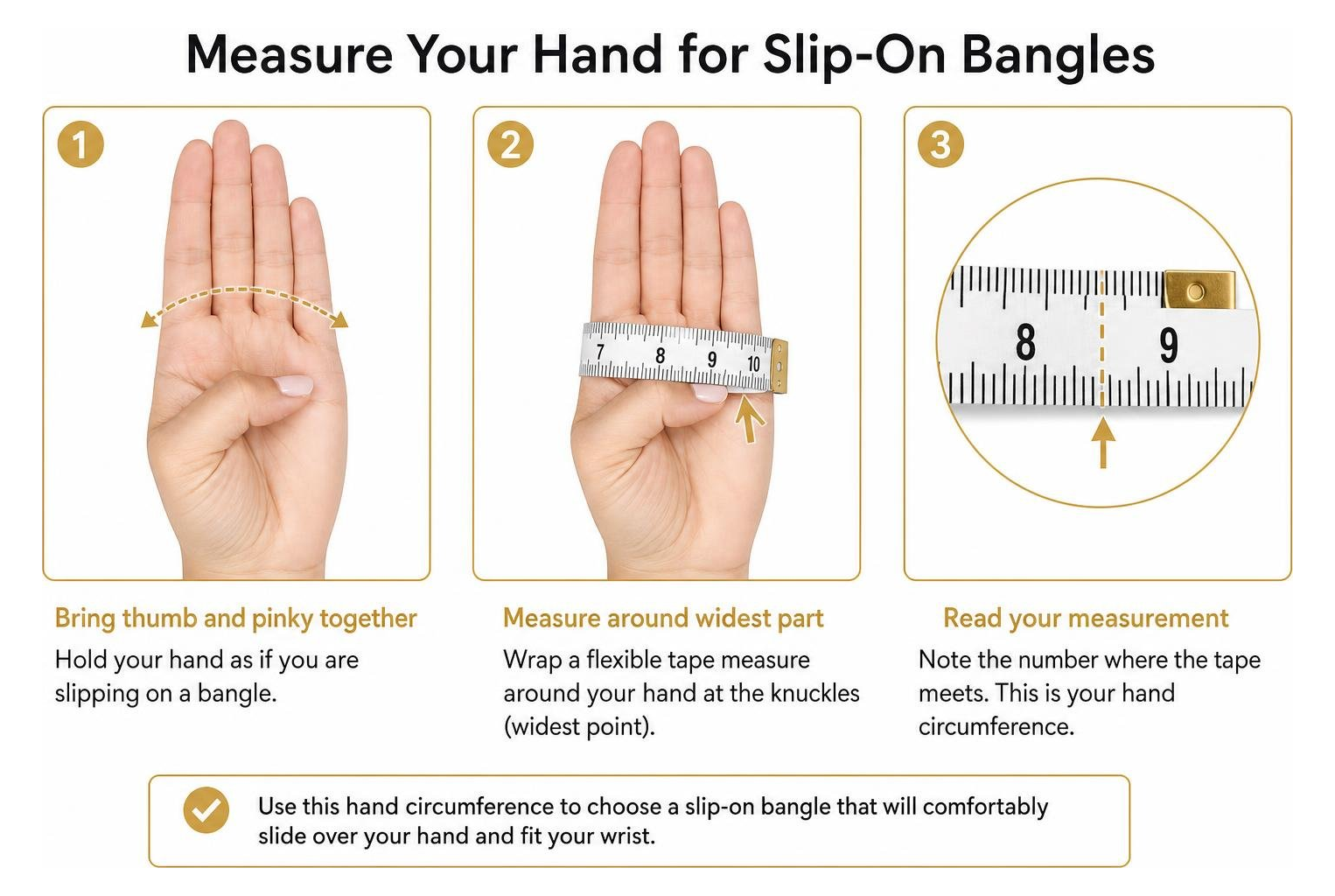
How to Accurately Size Slip-On Bangle Bracelets
Slip-on bangles have no opening, so they must be sized to fit the widest part of your hand when compressed, not your wrist.
- Position your hand: Bring your thumb and pinky finger together across your palm, as if you are slipping on a bracelet.
- Wrap your knuckles: Take a flexible measuring tape or a strip of paper and wrap it snugly around the widest point of your hand (across your base knuckles and the folded thumb joint).
- Record the measurement: Mark the overlap point. This gives you your hand circumference in inches or centimeters.
- Convert to diameter: Divide your hand circumference by 3.14 (pi) to find your target inner diameter.
If your hand measurement falls between two sizes, choose the larger size for a relaxed slide or the smaller size for a snug fit that stays higher on your forearm.
Sizing Hinged and Flexible Bangles for Petite to Full Wrists
Because hinged and expandable bangles open completely or stretch, hand size doesn't dictate your fit. Instead, focus on your actual wrist circumference:
- Petite Wrists (5.5" to 6.25"): Look for hinged bangles with an inner oval diameter of 54mm to 57mm. An oval shape prevents the bangle from spinning, keeping gemstone accents resting on top of the wrist.
- Standard Wrists (6.5" to 7.25"): The most common category. A standard 60mm inner diameter or a memory-wire flexible bangle offers comfortable movement without slipping over the hand.
- Full Wrists (7.5" to 8.5"): Look for hinged designs sized 7.5 inches or higher. Flexible memory-core bangles are also an excellent option, as they adjust comfortably without pinching the skin.
Everyday Wear and Styling Guide
A structured bangle brings clean lines and polished balance to any jewelry stack. The trick to stacking is mixing structural shapes, metal colors, and surface finishes so each piece stands out.
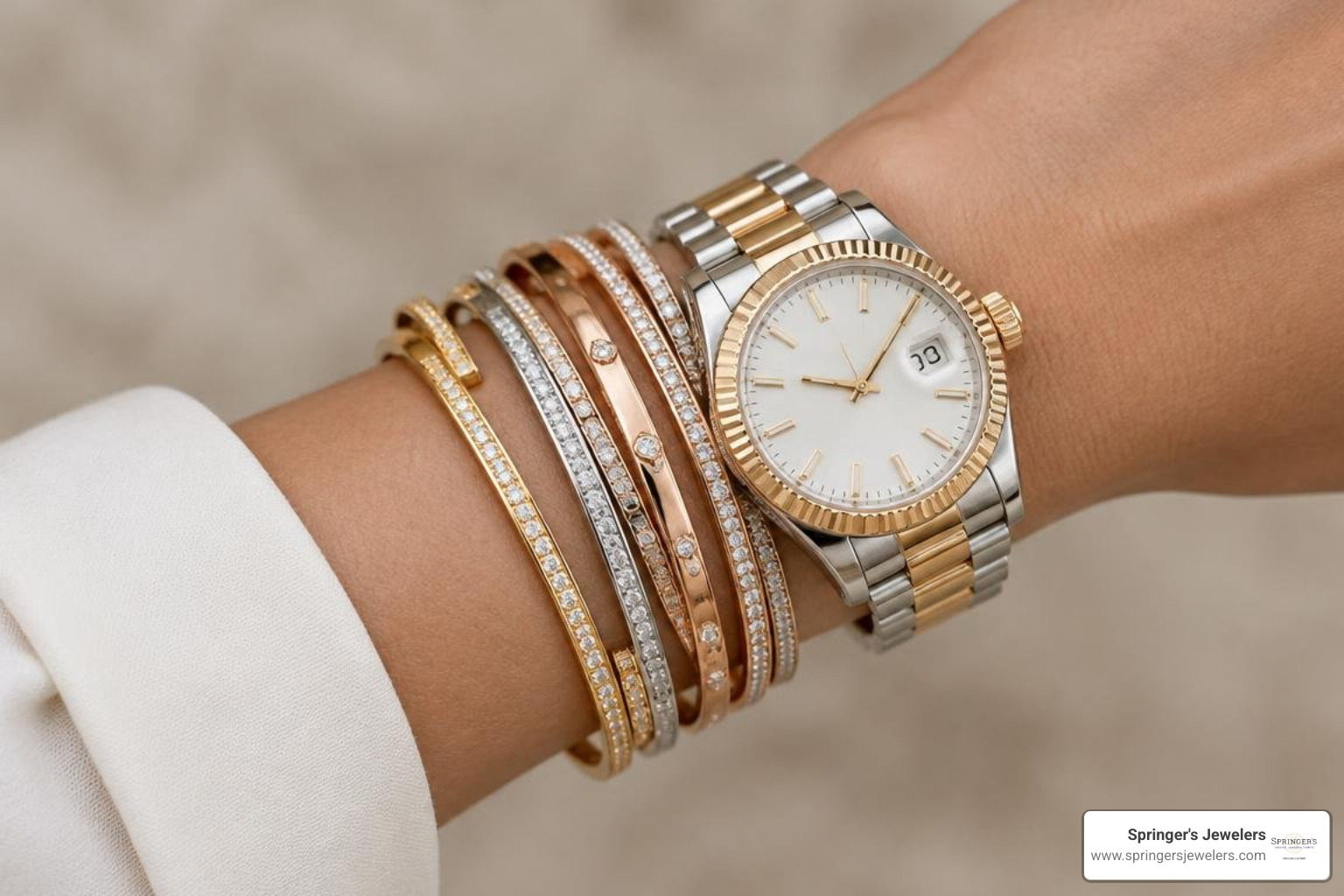
Styling and Stacking Bangle Bracelets with Other Jewelry
- Combine Contrasting Silhouettes: Pair a solid, high-polish slip-on bangle with a textured or ribbed hinged design. The smooth surface balances the detailed metalwork, creating visual depth without feeling busy.
- Mix Your Metals with Purpose: Gone are the days of sticking strictly to one metal color. Try combining yellow gold, white gold, and rose gold in your stack. To keep the look cohesive, choose one dominant metal (such as yellow gold) and use a two-tone bangle or a diamond-accented piece to bridge the colors naturally.
- Pair with a Luxury Timepiece: A slim hinged bangle worn just above your watch adds a refined layer of shine. Match the bangle metal to your watch case or dial markers, and ensure the bangle fits snugly so it doesn't slide under or scratch the watch bezel.
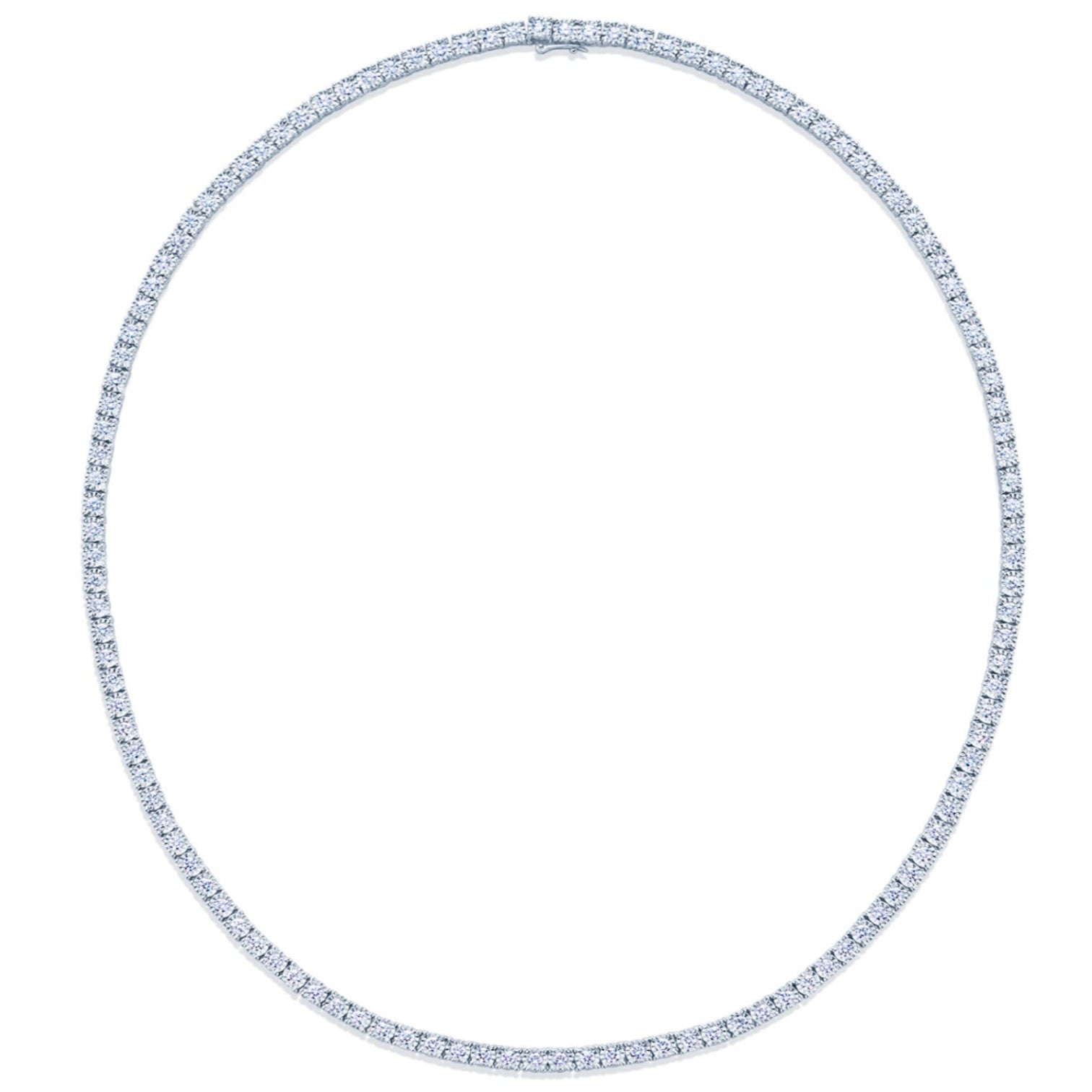
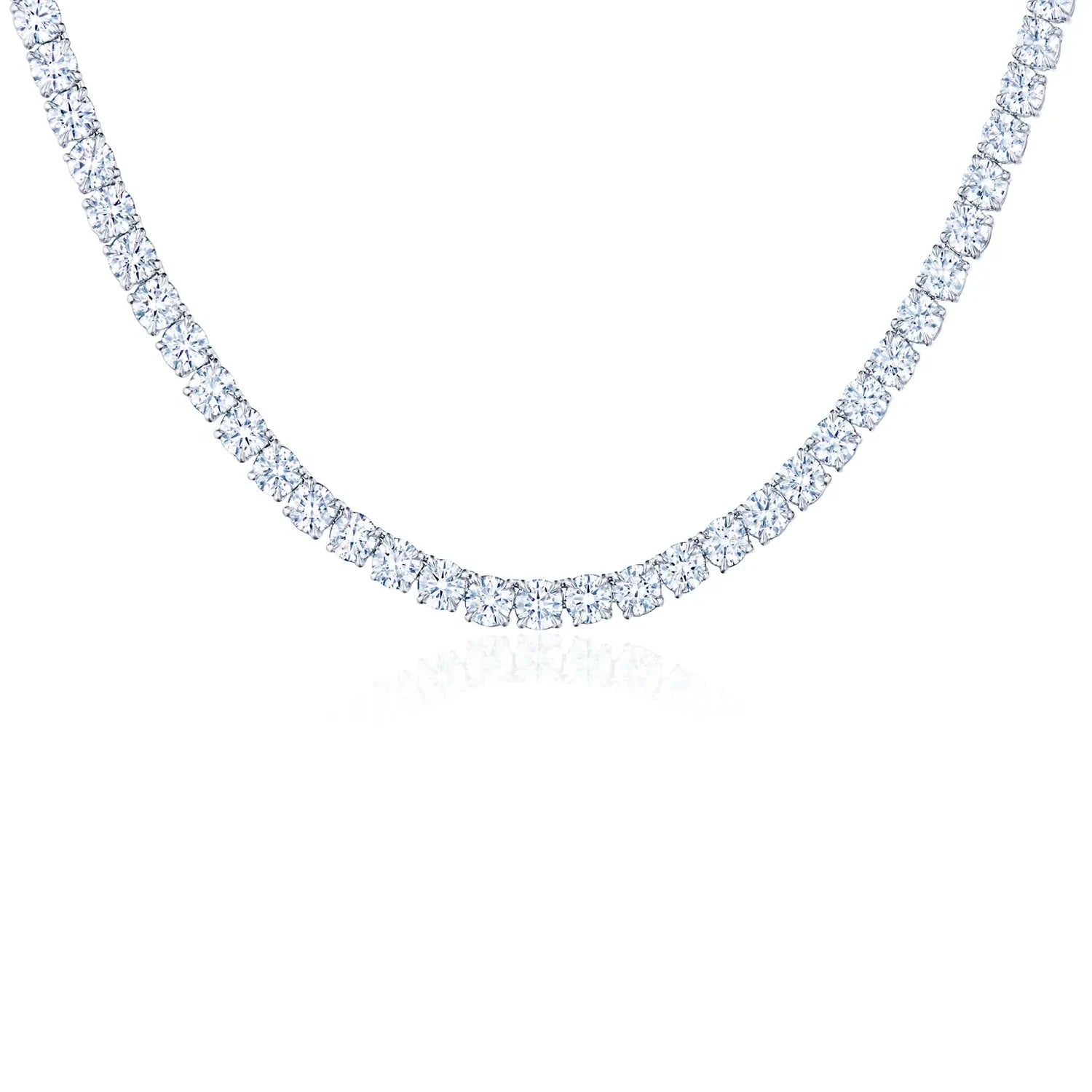
- Balance a Tennis Bracelet: A flexible gemstone or pavé diamond bangle pairs beautifully with a fluid tennis bracelet. The firm curve of the bangle provides structural support, keeping the supple links of the tennis bracelet from tangling.
Frequently Asked Questions About Bangle Bracelets
Can you wear bangles in the shower, pool, or gym?
It depends on the metal and construction:
- In the Shower: Solid 14K/18K gold, platinum, and PVD stainless steel are safe in freshwater. However, body washes, shampoos, and conditioners can leave a dull film behind gemstone settings. Sterling silver and gold-plated pieces should be kept dry to prevent tarnishing and premature wear.
- In the Pool and Hot Tub: Never wear fine jewelry in chlorinated water. Chlorine can cause stress-corrosion cracking in gold alloys—weakening prongs, hinges, and solder joints—and will rapidly discolor sterling silver.
- At the Gym: Heavy weights, kettlebells, and fitness equipment can easily bend hollow or slim bangles and scratch polished metal surfaces. We recommend storing fine bangles safely in a soft pouch before workouts.
Which bangle materials are best for sensitive skin and nickel allergies?
If you have sensitive skin or a nickel allergy, choose hypoallergenic metals:
- 18K Solid Gold & Platinum: High-karat gold and platinum are naturally inert and free of irritating alloys, making them the safest choice for everyday wear.
- 316L Marine-Grade Stainless Steel: High-grade 316L steel binds nickel tightly within its molecular structure, preventing it from leaching onto the skin.
- Nickel-Free 14K Gold & Sterling Silver: Premium jewelers use copper, silver, or zinc rather than nickel to harden yellow gold and sterling silver, ensuring smooth, irritation-free wear.
How do you keep stacked bangles from scratching each other?
All metal jewelry naturally develops fine character marks over time, but you can minimize heavy scuffs with a few simple habits:
- Separate with Spacer Bracelets: Place a smooth leather cord, silicone band, or bead bracelet between polished metal bangles to prevent direct contact.
- Vary Your Textures: Stack hammered, ribbed, or brushed bangles alongside mirror-polished pieces. Textured finishes disguise micro-abrasions, keeping the overall stack looking fresh.
- Match Metal Hardness: Avoid stacking softer metals like 24K gold or pure silver directly against harder metals like platinum or stainless steel, which can wear down the softer piece over time.
Conclusion
Structured bangle bracelets bring timeless polish and modern edge to any wardrobe. Whether you love the classic chime of handmade solid gold slip-ons, the tailored fit of a diamond hinged bangle, or the effortless comfort of expandable memory designs, choosing the right construction makes all the difference.
Since 1870, our team at Springer’s Jewelers has helped generations of New England families find, style, and care for exceptional jewelry. Explore our curated designer bracelet collection online, or visit our showrooms in Portland, ME, Bath, ME, or Portsmouth, NH to find your perfect fit in person.