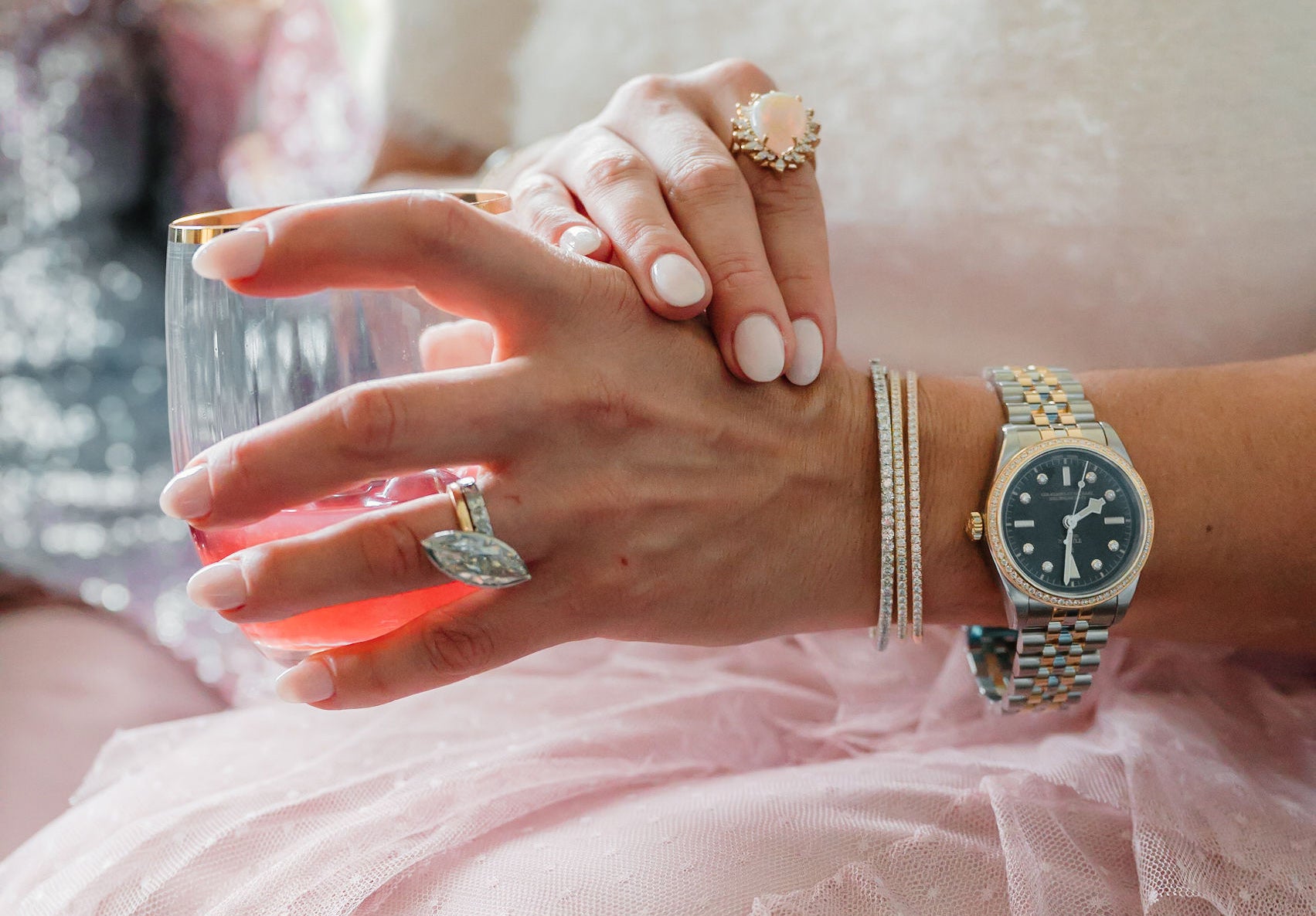



Why Choose 14k Gold Rings for Everyday Wear?
14k gold rings are a practical choice if you want a ring to wear often. They contain 58.33% gold, with other metals added for strength. Compared with 18k gold, they generally cost less and resist dents better. Compared with 10k gold, they contain more pure gold. They also come in yellow, white, and rose tones, so you can choose a look that suits you.
The best choice still depends on your budget, skin sensitivity, and how you wear your ring. We are Springer's Jewelers, Northern New England's oldest jeweler, serving customers since 1870. Our experience with 14k gold rings helps us explain what matters before you buy.
Understanding Gold Purity and Metallurgy in 14k Gold Rings
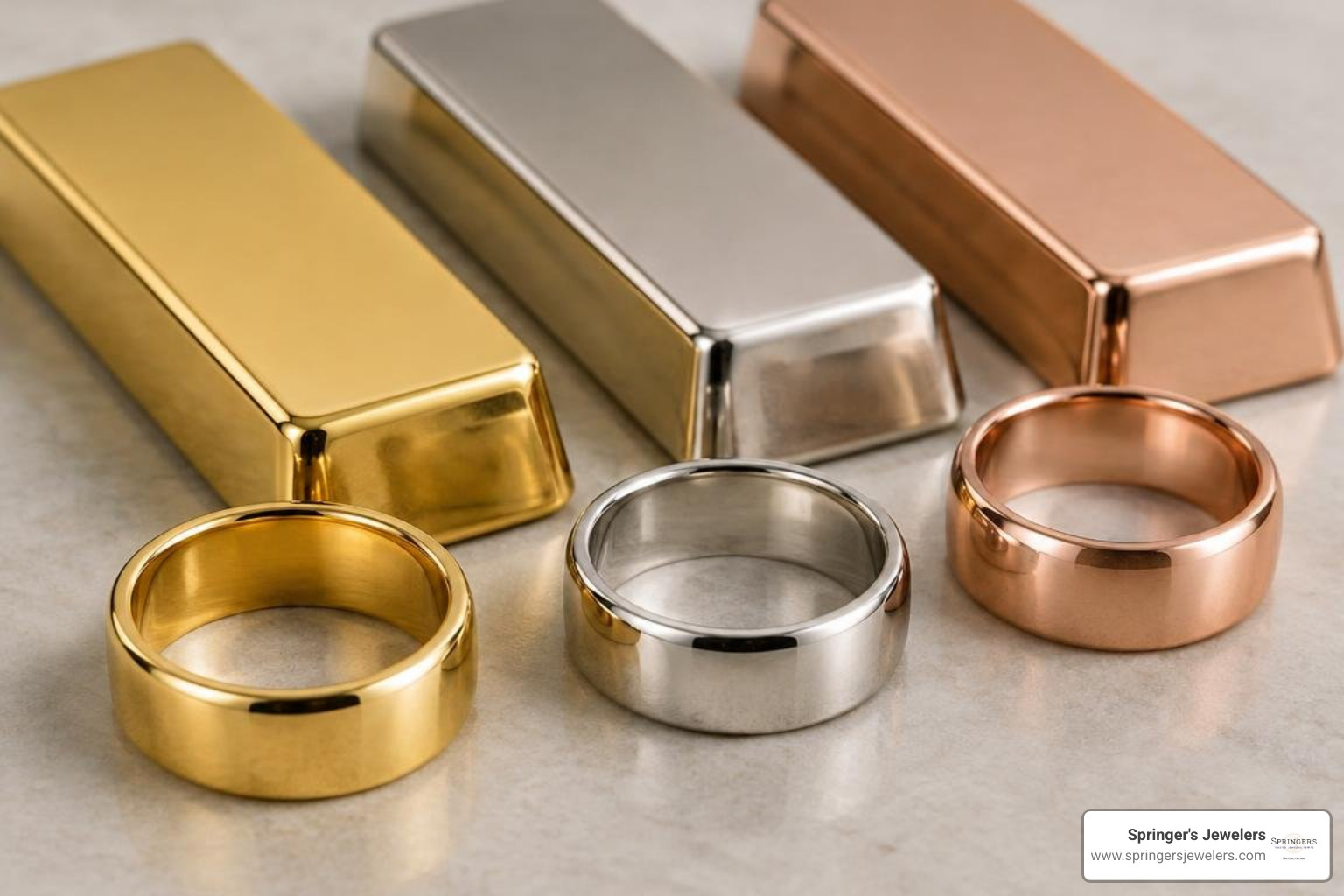
To appreciate why 14-karat gold has remained the gold standard for fine jewelry across New England for generations, you have to look closely at its elemental makeup. Pure elemental gold (24 karat, atomic number 79) is a geological wonder. It is remarkably dense, non-reactive, and the most malleable metal on Earth—a single gram can be hammered into a gossamer sheet measuring an entire square meter.
However, that extreme malleability makes pure 24k gold entirely unsuited for fine rings. On the Mohs scale of mineral hardness, pure gold rates at roughly 2.5—similar to a human fingernail. If you were to wear a solid 24k band every day, everyday tasks like turning a doorknob or carrying groceries would quickly bend, warp, or gouge the metal, putting any gemstone settings at serious risk.
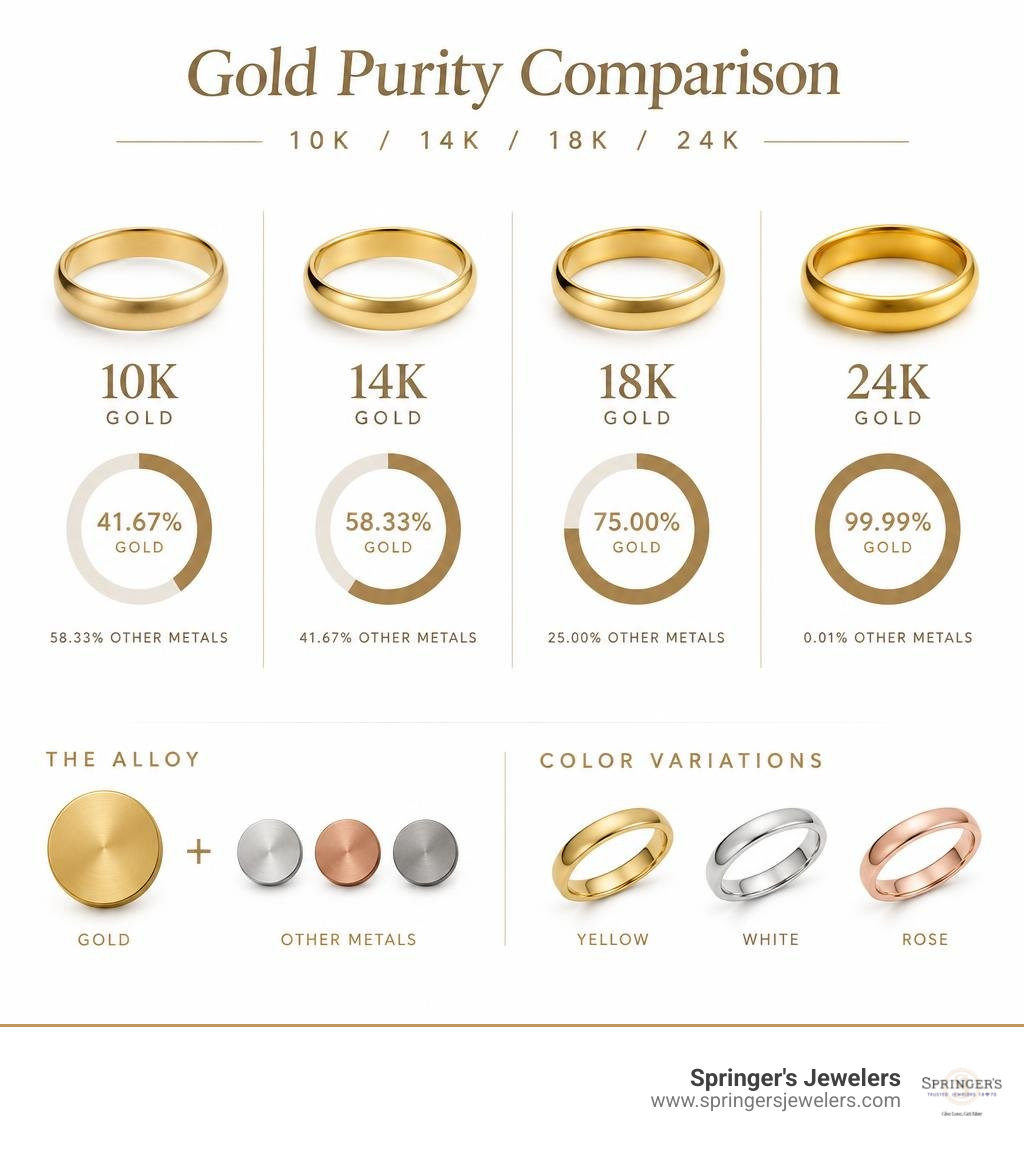
Jewelers solve this by creating gold alloys: blending pure gold with stronger structural metals like copper, silver, zinc, nickel, or palladium. The purity of these alloys is measured in 24ths (karats):
- 24-karat gold: 24/24 parts gold (99.9% pure)
- 18-karat gold: 18/24 parts gold (75.0% pure)
- 14-karat gold: 14/24 parts gold (58.33% pure)
- 10-karat gold: 10/24 parts gold (41.67% pure)
When shopping for authentic jewelry, you will often find an official assay stamp inside the band. In Europe and modern international trade, 14k gold is stamped with the fineness mark "585" (or sometimes "583"), indicating that the alloy contains 58.3% to 58.5% pure gold by weight.
Why 14k Gold Rings Strike the Perfect Balance of Hardness and Ductility
Metallurgy is an art of delicate trade-offs. If an alloy contains too much soft gold, it loses scratch resistance and structural rigidity. If it contains too little gold and too much base metal, it can become brittle, difficult to resize, and prone to surface oxidation.
Fourteen-karat gold sits in the sweet spot between structural hardness and workable ductility. The 41.67% alloy portion reinforces the atomic matrix of the metal, significantly raising its yield strength and tensile strength. This makes 14k gold stiff enough to hold delicate gemstone prongs securely in place, while preserving enough ductility so bench jewelers can cleanly resize, reshape, and polish the ring over a lifetime of wear.
| Karat Rating | Gold Purity (%) | Fineness Stamp | Mohs Hardness | Typical Durability & Best Use |
|---|---|---|---|---|
| 10k | 41.67% | 417 | ~3.5 – 4.0 | Highly scratch-resistant, but brittle; prone to tarnish |
| 14k | 58.33% | 585 | ~3.0 – 3.5 | Optimal balance of scratch resistance, ductility, and color |
| 18k | 75.00% | 750 | ~2.75 – 3.0 | Rich, warm color; softer surface prone to scuffs and dings |
| 24k | 99.90%+ | 999 | ~2.5 | Extremely soft; impractical for everyday rings |
Color Profiles and Hypoallergenic Alloys in 14k Gold Rings
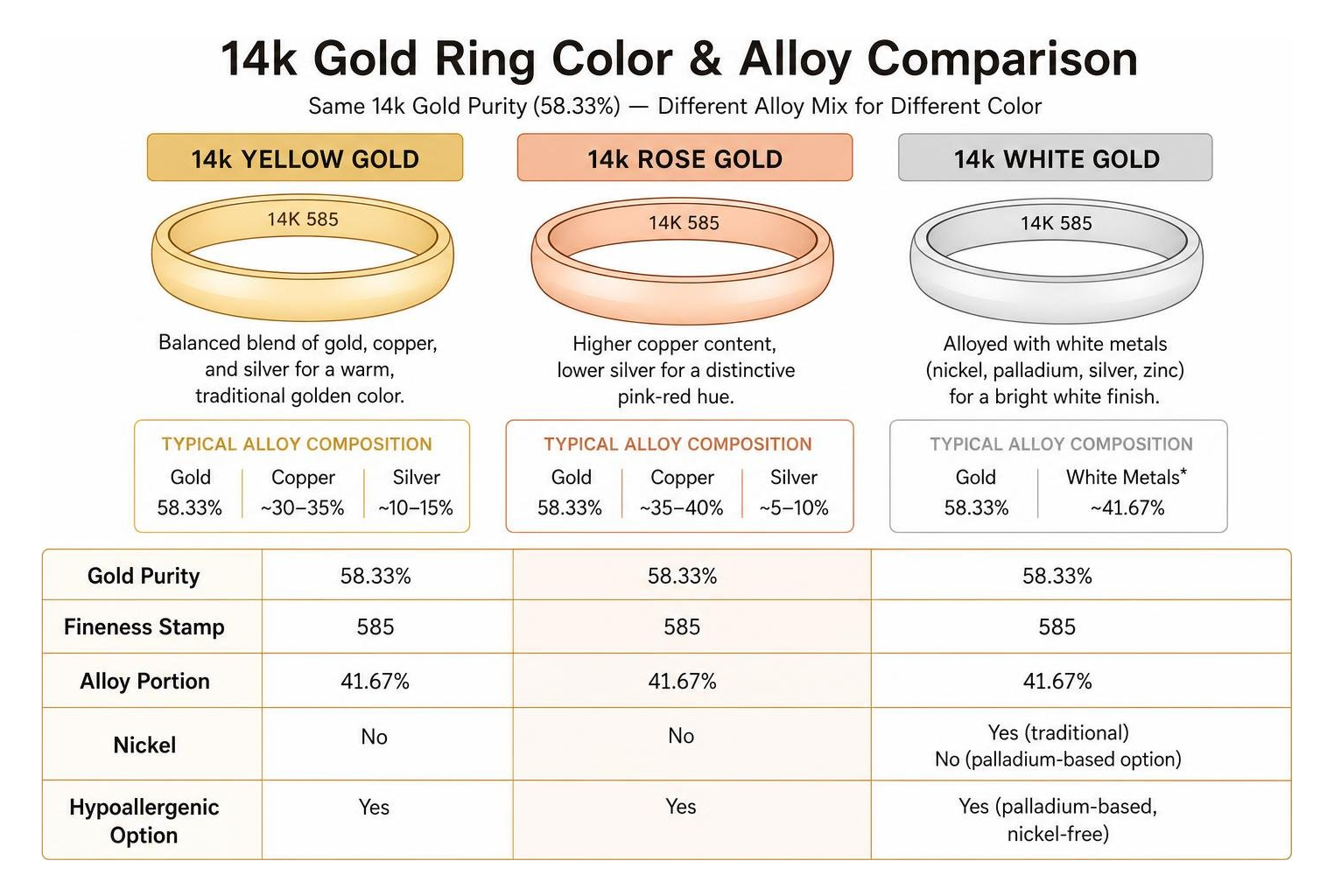
One of the great advantages of 14k metallurgy is its versatility in color. Pure gold is always a deep, rich yellow. By adjusting the specific balance of the 41.67% alloy mix, master jewelers can produce three primary color families without altering the overall karat purity:
- 14k Yellow Gold: Formulated with a balanced blend of pure gold, warm copper, and bright silver. This preserves a sunny, traditional golden glow while providing substantial wear resistance.
- 14k Rose Gold: Formulated by increasing the copper ratio and decreasing silver. The copper creates a distinctive pink-red hue reminiscent of classic vintage heirlooms.
- 14k White Gold: Created by alloying yellow gold with naturally white metals such as nickel, palladium, silver, and zinc.
Because standard 14k white gold naturally retains a faint champagne or warm undertone, finished pieces are traditionally electroplated with ultra-bright rhodium (a rare platinum-group metal). This produces a mirror-bright, cool silver finish.
Allergy Considerations and Hypoallergenic Options
If you have sensitive skin, alloy chemistry is an important detail to keep in mind. Nickel is traditionally used in white gold alloys to bleach the yellow hue and add hardness. However, nickel contact dermatitis affects roughly 10% to 15% of the population.
For clients with sensitive skin, palladium-based white gold alloys offer a hypoallergenic, nickel-free alternative that stays bright and gentle on the skin. High-quality classic styles—such as our 14k white gold comfort fit half round wedding band—are carefully alloyed and finished to deliver exceptional skin comfort and long-term durability.
The 5 Practical Reasons 14k Gold Outperforms Other Karats

When selecting an engagement setting, wedding band, or signature statement piece, choosing a metal involves balancing daily practicality against fine craftsmanship. Here are the five practical reasons why 14-karat gold consistently outperforms other karats for everyday rings:
1. Superior Scratch and Dent Resistance for Active Lifestyles
Daily life puts constant wear on our hands. From holding steel steering wheels and typing on laptops to handling gym equipment, your ring constantly encounters harder surfaces.
Because 14k gold contains 41.67% strengthening alloys, it resists surface scratches, gouges, and deep impact dents far better than softer 18k or 22k gold. It retains its crisp edges, intricate milgrain detailing, and hand-engraved patterns for decades without wearing smooth.
2. Maximum Prong Integrity and Gemstone Security
The most vulnerable part of any gemstone ring is the setting. Thin gold prongs must hold valuable diamonds and colored gemstones securely under constant daily friction.
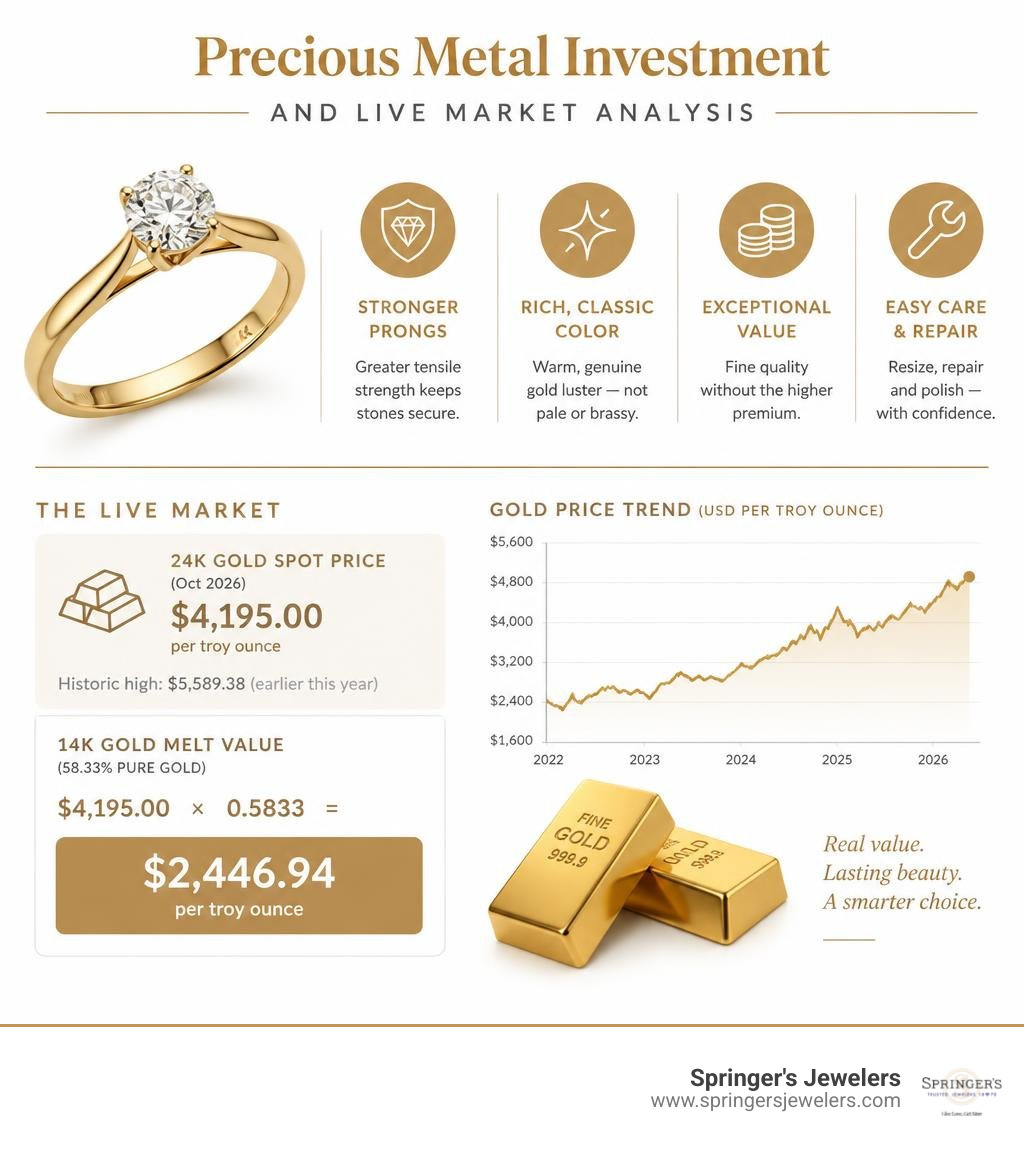
Prongs cast in 18k or 24k gold can bend outward relatively easily when snagged on knitwear, pockets, or upholstery, which can cause stones to loosen or fall out. Fourteen-karat gold has higher tensile strength, making prongs stiffer and far less likely to pull open accidentally.
3. Rich, Classic Aesthetic Without the "Brassy" 10k Look
While 10k gold is slightly harder than 14k, it contains less than 42% pure gold. As a result, 10k yellow gold can often look pale or slightly greenish-brown. In contrast, 14k yellow gold retains a rich, warm golden luster that looks right at home beside high-karat vintage jewelry, while avoiding the overly saturated orange-yellow tone of 22k gold that some find hard to pair with modern wardrobes.
4. Exceptional Value and Everyday Cost-Efficiency
Fourteen-karat gold provides a smart balance between fine jewelry prestige and sensible value. Because you are not paying the higher raw-material premium of 18k gold or platinum, more of your budget can go directly toward center stones, custom design details, or complementary heirloom jewelry.
5. Effortless Maintenance, Sizing, and Long-Term Repairability
Over a lifetime of wear, your fingers naturally change size, bands experience minor wear, and settings need occasional maintenance.
Some metals—like platinum, titanium, and lower-karat brittle alloys—require specialized laser welders or can be difficult to resize cleanly. Fourteen-karat gold is universally loved by bench jewelers. It can be easily resized, seamlessly soldered, laser-welded, and polished back to a showroom shine without compromising the structural integrity of the shank.
Comparing 14k Gold to 10k, 18k, and Platinum Settings
To help you decide which precious metal matches your routine, here is how 14k gold compares to the other popular fine ring metals:
- 14k Gold vs. 10k Gold: 10k gold is the legal minimum purity for commercial gold jewelry in the United States. While very hard, its high base-metal content makes it significantly more prone to surface tarnish when exposed to household chemicals, perspiration, or cosmetics. It is also more brittle, which can make extensive ring resizing more difficult. Fourteen-karat gold will not tarnish under normal conditions and offers a warmer, richer color.
- 14k Gold vs. 18k Gold: Eighteen-karat gold is luxurious, offering a rich 75% gold purity that feels wonderfully substantial on the hand. However, it scuffs and develops a soft patina much faster than 14k. For delicate, high-set gemstone pieces—such as our 14k yellow gold aquamarine ring—a 14k gold setting provides extra peace of mind for regular wear.
- 14k Gold vs. Platinum: Platinum is a naturally white, dense, hypoallergenic metal. It does not wear away over time; instead, surface metal displaces into a soft patina. However, platinum is roughly 30% heavier than 14k gold and significantly more expensive to fabricate, size, and repair. Fourteen-karat white gold delivers that bright, modern look at a much more accessible price point.
Real Market Value, Pricing Factors, and Investment Potential
When buying fine jewelry, it helps to understand how finished retail prices relate to baseline commodity spot prices.
As of October 2026, the global benchmark spot price for pure 24-karat gold trades at $4,195.00 per troy ounce (with historic highs reaching $5,589.38 earlier this year). Because 14k gold contains exactly 58.33% pure gold, its baseline metal value—often called its melt value—is calculated directly from the spot market. At that spot price, the melt value of 14k gold works out to roughly $2,446.94 per troy ounce.
Converting this to standard jeweler grams (where 1 troy ounce equals 31.1035 grams):
- Raw 24k gold value: approximately $134.87 per gram
- Raw 14k gold melt value: approximately $78.67 per gram
What Shapes the Price of a 14k Gold Ring?
While raw gold content sets the price floor, a finished piece of jewelry is much more than its weight in scrap metal. Several key factors determine retail value:
- Design and Master Bench Craftsmanship: Intricate filigree, precision-cut prongs, custom sizing, hand-applied engraving, and comfort-fit profiling require hours of skilled labor from experienced bench jewelers.
- Gemstone and Diamond Quality: Cut, color, clarity, and carat weight often represent a significant portion of a ring's total appraised value.
- Alloy Sourcing and Environmental Standards: Responsibly sourced, sustainably refined precious metals and conflict-free gems require rigorous supply-chain oversight. Local municipalities and established jewelers follow strict precious-metal trade guidelines, such as those outlined by the City of Portland, to protect consumers and guarantee authenticated metal purities.
Solid 14k Gold vs. Gold-Filled and Gold-Plated Jewelry
Understanding the difference between solid 14k gold and bonded surface treatments is essential for choosing pieces built to last:
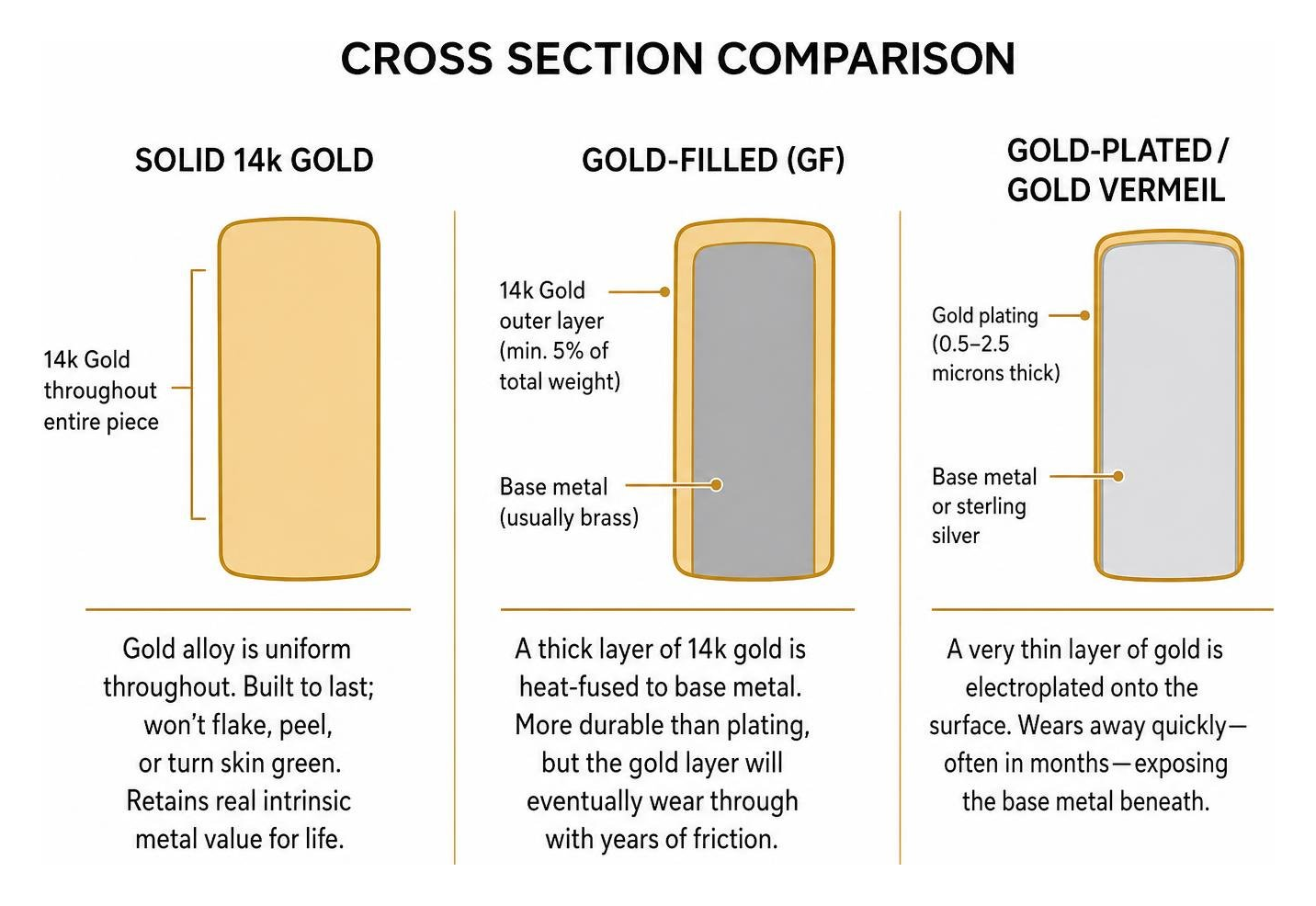
- Solid 14k Gold: The gold alloy is uniform throughout the entire piece. It will never flake, peel, chip, or turn your skin green, and it retains real intrinsic metal value for life.
- Gold-Filled (GF): A mechanical bonding process where a thin sheet of karat gold is heat-fused over a base metal (usually brass). By law, the gold layer must equal at least 5% (1/20th) of the item's total weight. While more durable than electroplating, the surface layer will eventually wear through after several years of friction.
- Gold-Plated / Gold Vermeil: Base metals (or sterling silver, in the case of vermeil) are submerged in an electroplating tank to deposit a microscopic film of gold (often just 0.5 to 2.5 microns thick). This delicate surface can rub away in a matter of months with regular wear, exposing the base metal beneath.
Essential Care and Maintenance for Lasting Luster
Fourteen-karat gold is built for daily life, but a few simple care habits will keep your rings looking their absolute best for generations:
Routine Home Cleaning
To safely clear away hand lotions, natural skin oils, and ambient dust:
- Mix a few drops of mild, phosphate-free dish soap into a bowl of warm (not boiling) water.
- Let your 14k ring soak for 10 to 15 minutes to loosen trapped debris.
- Gently brush around and beneath gemstone settings using a new, baby-soft toothbrush.
- Rinse thoroughly under warm running water (remember to close the sink drain first!).
- Pat dry with a clean, lint-free microfiber cloth.
Chemical Precautions
The pure gold in your ring will not oxidize or tarnish, but the alloyed base metals (copper, zinc, and nickel) can react when exposed to harsh chemicals.
Always remove your rings before:
- Swimming in chlorinated pools or relaxing in hot tubs (chlorine causes severe stress-corrosion cracking in gold alloys over time).
- Using household bleach, ammonia, or abrasive scrubbing cleansers.
- Applying heavy garden fertilizers or sulfur-based skin treatments.
Storage and Professional Inspections
Store your rings in individual fabric-lined jewelry pouches or dedicated slots in a jewelry box to prevent diamonds from scratching adjacent metal bands.
Finally, bring your fine rings to a full-service jeweler once a year. Our team can check prong tightness under a microscope, refresh the polish, and make sure your settings remain strong and secure.
Frequently Asked Questions About 14k Gold Rings
Can 14k gold rings be worn in water and during daily activities?
Yes. Solid 14k gold is water-resistant and will not rust or degrade when exposed to fresh water, showers, or dishwashing.
However, soaps and conditioners can leave a cloudy film behind gemstones over time, requiring more frequent cleanings. It is best to remove your rings before swimming in chlorinated pools, applying heavy lotions, or lifting weights at the gym to avoid chemical damage and accidental surface dings.
How do you identify authentic 14k gold hallmarks?
Authentic 14k jewelry is stamped with an assay mark on the inner band. Look for stamps such as "14K", "14KT", "14k", or the metric fineness number "585" (which indicates 58.5% gold purity). High-grade designer jewelry will also feature a registered maker's trademark next to the karat stamp.
If an older heirloom has lost its hallmark due to past ring sizing, an experienced jeweler can safely confirm its gold content using electronic testing or non-invasive X-ray fluorescence (XRF) analysis.
Does 14k gold hold reliable resale and melt value?
Yes. Because solid 14k gold contains an exact 58.33% ratio of pure elemental gold, it always retains intrinsic precious-metal melt value based on live commodity spot markets.
Beyond its raw metal scrap value, well-crafted 14k gold estate rings, signed designer pieces, and natural gemstone settings often carry significant resale and heirloom value on the secondary jewelry market.
Conclusion: The Timeless Practicality of 14k Gold
Choosing the right ring metal comes down to matching beauty with long-term wearability. While 18k gold offers deep color and platinum provides substantial weight, 14k gold rings continue to be the most practical, durable, and versatile choice for daily life.
With its smart balance of scratch resistance, secure prong strength, rich color options, and accessible pricing, 14k gold is designed to be worn and enjoyed every single day.
At Springer's Jewelers, our family has guided New Englanders through their milestone jewelry choices since 1870. Across four generations of hands-on expertise, our certified bench jewelers have sized, restored, and custom-crafted thousands of heirloom pieces across our stores in Portland and Bath, Maine, and Portsmouth, New Hampshire.
Whether you are looking for an engagement ring, a classic wedding band, or a custom milestone gift, explore our curated collection of fine rings online or visit one of our New England showrooms to find a piece made to last for generations.